Psychological records contain more than personal details
Psychological records contain some of the most sensitive information a person may share with a professional. Anonymization helps practices protect client confidentiality while preparing documents for supervision, consultation, training, or other approved uses.
Psychological records may contain far more than a client’s name and contact details. Session notes, intake forms, assessments, and psychological opinions can describe a person’s mental health, family relationships, past crises, professional situation, medication, and reasons for seeking support.
These documents may also include information about partners, children, parents, doctors, teachers, and employers. A single file may therefore contain personal data relating to several people, even when only one of them is a client of the practice.
The challenge arises when a document needs to be used outside its primary workflow, for example during supervision, consultation with another specialist, professional training, transfer to another organization, or work with an approved AI tool. In these situations, the full original version is often unnecessary.
Instead of sharing the source document, the practice can prepare a separate copy containing only the information required for a specific purpose.
Why psychological records require particular care
Information about a person’s mental health, diagnosis, treatment, medication, or psychological difficulties may qualify as health data. Under the GDPR, health data belongs to a special category of personal data and requires a higher level of protection.
The principle of data minimization also applies. Organizations should process information that is adequate, relevant, and limited to what is necessary for a clearly defined purpose.
In practice, this means that a document prepared for supervision does not need to contain every piece of information held in the client’s file. A supervisor may need to understand the client’s difficulties, family background, therapy process, and the psychologist’s response to the situation. They will usually not need the client’s national identification number, exact address, private telephone number, signature, or payment details.
The same applies to consultation with another specialist. When the purpose is to discuss one aspect of a case, sharing the entire record may be unnecessary. A safer approach is to prepare a copy limited to the information the recipient actually needs.
Confidentiality is fundamental to the relationship between a psychologist and a client. Preparing a document for further use should therefore involve more than quickly removing a name from the first page. The complete document, its attachments, and its technical properties should be reviewed.
Which documents may require anonymization?
Client data may appear in many documents used in the daily work of a psychological practice, including:
- registration and intake forms;
- initial interviews;
- consultation notes;
- psychological opinions;
- test results;
- certificates;
- records concerning children and their guardians;
- correspondence with clients;
- scans received from doctors, schools, or other institutions;
- materials prepared for supervision.
These documents may contain names, national identification numbers, dates of birth, addresses, telephone numbers, email addresses, signatures, health information, family details, names of employers or educational institutions, bank account numbers, and payment information.
Not all of these details are required every time a document is used.
When a psychologist wants to discuss the therapy process, billing information is irrelevant. When the purpose is to improve the wording of an opinion, there is no need to share a header containing the client’s full details. If a case is being used in training, information that could identify the person described should be removed from the prepared copy.
The original document should remain in the protected environment of the practice. A separate version should be created for the specific intended use.
How can a psychologist prepare a document manually?
Manual anonymization is possible, but it requires a careful review of the entire document. Removing a person’s name is not enough. Personal data may appear in headers, footers, tables, attachments, stamps, signatures, handwritten notes, and file names.
The process should begin by defining the purpose. The psychologist needs to know who will receive the document and what information that person requires.
1. Create a copy of the document
Anonymization should not be performed on the only existing version of the record. The original should remain stored and protected in accordance with the practice’s documentation and security procedures.
All further work should be carried out on a separate copy.
2. Limit the amount of material
The entire document may not be necessary. In many cases, a selected section of an opinion, a few pages, or a description of one stage of the therapy process will be sufficient.
The less unnecessary information included in the copy, the less data will need to be removed later.
3. Identify information that requires protection
The document should be reviewed page by page. Attention should be paid not only to the client’s data but also to information concerning other people.
This may include:
- identifying information;
- contact details;
- document and identification numbers;
- signatures;
- health-related information;
- details about family members;
- financial data;
- information about employers, schools, and institutions;
- data included in tables and attachments.
4. Remove or replace information
Details that are not required by the recipient can be permanently removed. In some cases, they may be replaced with neutral descriptions such as “Client A,” “the client’s partner,” or “the employer.”
If the practice can still reconnect the identifier with a particular person, the document has been pseudonymized rather than fully anonymized. It should therefore continue to receive appropriate protection.
5. Check the technical contents of the file
Placing a black rectangle over a name does not always remove the underlying text. The information may remain in the document’s text layer and could still be selected, copied, or found using search.
The file name should also be checked. A file named Psychological_Opinion_John_Smith.pdf continues to reveal the client’s identity even if the name has been removed from the document itself.
For scanned documents, attention should also be paid to signatures, handwritten notes, stamps, and information located in the margins.
6. Perform a final review
Before the document is shared, the prepared version should be read again to confirm that it contains only the information necessary for its intended purpose.
Only after this review should the copy be used for supervision, consultation, training, or another approved process.
Manual anonymization takes time on every page
The main cost of manual anonymization is the specialist’s time.
A psychologist must open the document, read each page, identify the data, mark and remove it, and then verify the completed file. A short opinion may require several minutes of work. With larger numbers of documents, the process can take several hours each month.
This time cannot be used for client consultations, session preparation, supervision, or other work that requires the psychologist’s professional expertise.
The process is also repetitive. Similar categories of information must be found in every document, including identifying data, contact details, health information, financial information, and other protected elements.
Automated classification shortens this stage. Instead of beginning with a manual search through every page, the psychologist starts with a document in which detected data has already been identified and organized.
How Bluur supports document anonymization in a psychological practice
Bluur automatically analyzes documents and classifies detected information into 32 data categories. Users do not need to begin by manually searching for each item from the first page to the last.
The system supports the following formats:
- PDF;
- JPG;
- PNG;
- TIFF.
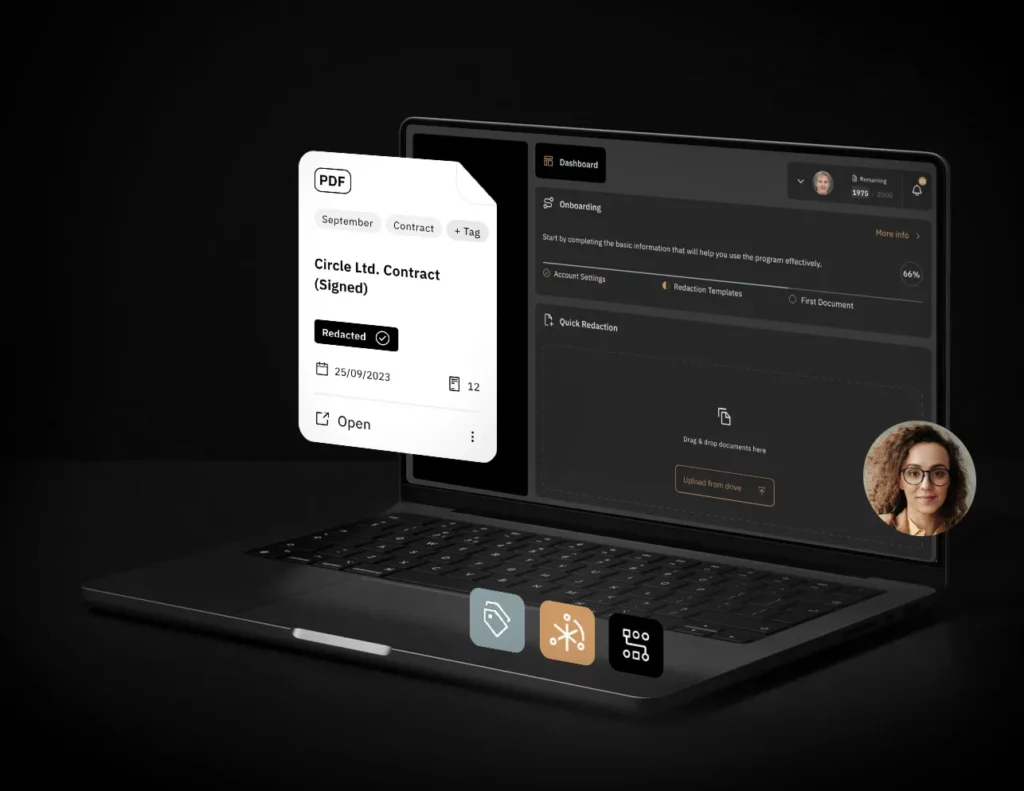
After a document is uploaded, Bluur classifies and highlights the detected information. The psychologist can review the results, select entire categories or individual items for anonymization, and download the prepared version of the document.
The process includes:
- uploading a copy of the document;
- automatically classifying information into 32 categories;
- reviewing the detected data;
- selecting information for anonymization;
- generating a redacted version of the document;
- performing a final user review;
- downloading the completed file.
The psychologist remains in control of the document and decides which information should be removed. The scope of anonymization can be adapted to the purpose for which the copy is being prepared.
A version prepared for supervision may differ from a document intended for consultation or training. Bluur allows the user to begin with a classified document rather than manually searching for all data from scratch.
The Pro 200 plan for a psychological practice
The Pro 200 plan costs USD 54 per month and allows users to anonymize up to 200 pages per month. Two users can work within the plan, and each page above the monthly limit costs USD 0.28.
For the following calculation, an exchange rate of:
USD 1 = PLN 3.8046
has been used.
| Plan element | Price in USD | Price in PLN |
|---|---|---|
| Pro 200 plan | USD 54.00 | PLN 205.45 |
| Additional page | USD 0.28 | PLN 1.07 |
| Monthly allowance | 200 pages | 200 pages |
| Number of users | 2 | 2 |
The final cost in Polish złoty may vary depending on the exchange rate used by the bank, payment provider, and applicable tax treatment.
Assumptions used in the ROI calculation
The following model was used to compare manual work with a process supported by Bluur:
- the practice anonymizes 200 pages per month;
- manual review and anonymization take an average of three minutes per page;
- classification with Bluur and final user verification take an average of one minute per page;
- the fully manual process requires approximately 10 hours per month;
- the process supported by Bluur requires approximately 3 hours and 20 minutes;
- the monthly time saving is approximately 6 hours and 40 minutes;
- the value of a psychologist’s working hour ranges from PLN 200 to PLN 300.
These are model assumptions. The actual time required will depend on the length and complexity of the document, scan quality, amount of detected data, and scope of the final review.
For simplicity, the price of one standard appointment has been treated as the value of one hour of the psychologist’s work. This is a conservative assumption because a typical session may last less than 60 minutes.
The ROI metrics below quantify the value of the time saved by the psychologist they do not represent a forecast of additional revenue.
Estimated ROI of the Pro 200 plan
| Value of one hour of the psychologist’s work | Cost of manually anonymizing 200 pages | Cost of the Bluur-supported process, including subscription | Monthly saving | Subscription ROI | Break-even point |
|---|---|---|---|---|---|
| PLN 200 / USD 52.57 | PLN 2,000 / USD 525.68 | PLN 872.12 / USD 229.23 | PLN 1,127.88 / USD 296.45 | 549% | approx. 31 pages |
| PLN 250 / USD 65.71 | PLN 2,500 / USD 657.10 | PLN 1,038.78 / USD 273.03 | PLN 1,461.22 / USD 384.07 | 711% | approx. 25 pages |
| PLN 300 / USD 78.85 | PLN 3,000 / USD 788.52 | PLN 1,205.45 / USD 316.84 | PLN 1,794.55 / USD 471.68 | 873% | approx. 21 pages |
The ROI was calculated using the following formula:
(value of time saved − subscription cost) ÷ subscription cost × 100%
When an hour of the psychologist’s work is valued at PLN 200, the plan reaches its break-even point after approximately 31 anonymized pages per month. At PLN 300 per hour, the break-even point falls to approximately 21 pages.
Using the full allowance of 200 pages saves approximately 6 hours and 40 minutes per month under the assumptions used in this model.
The recovered time does not need to be used exclusively for additional appointments. It can also be allocated to session preparation, supervision, professional development, documentation, or rest. In every case, it is time the psychologist no longer needs to spend manually searching for data across multiple pages.
Free tiral version: https://app.bluur.ai/#/register
More time for work that requires professional expertise
Document anonymization in a psychological practice requires accuracy. Records may contain information about clients, their relatives, their health, private lives, and professional circumstances.
Preparing documents manually is possible, but it becomes time-consuming as the number of pages increases. Each document must be reviewed, the relevant data identified and removed, and the final result checked.
Bluur shortens the data-search stage by classifying information into 32 categories and supporting the preparation of a redacted copy. The psychologist performs the final review and decides what information should remain in the document.
This allows anonymization to become a consistent and organized part of the practice’s workflow. Confidential information remains protected, while the specialist’s time can be used for work in which their knowledge and experience provide the greatest value.